
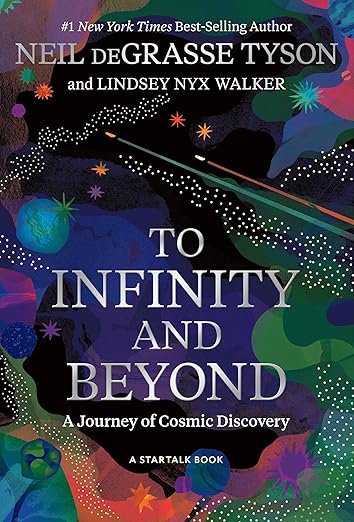
Cosmic Discovery – Item 464
$21.37
Explore the universe with Neil deGrasse Tyson’s latest book, blending science and humor. At $21.37 with free delivery options for Prime members. Perfect for science enthusiasts! 🌌📚
Discover the mysteries of the universe through Neil deGrasse Tyson’s engaging narrative in “To Infinity and Beyond.” This captivating book takes you from the Big Bang to the farthest reaches of space, merging scientific principles with history, mythology, and pop culture references. At just $21.37, this book offers both value and entertainment, along with free delivery for orders over $35 or faster shipping for Prime members.
**Key Features & Benefits**
• 🪐 Illustrated narrative – Makes complex astrophysics comprehensible and fun.
• 📖 Blend of humor and science – Tyson’s wit shines through as he unpacks cosmic phenomena.
• 💡 Engaging design – Vivid photographs and art make for an immersive reading experience.
**Product Details**
“To Infinity and Beyond” successfully captures the wonders of our universe while taking readers on a journey past our solar system. Tyson, alongside Lindsey Nyx Walker, brings a unique voice to this exploration filled with insights, laughs, and intriguing facts. The book is a must-have for anyone passionate about space and science, making it a valuable addition to your library.
**Best For**
Ideal for science lovers, casual readers, and anyone looking to deepen their understanding of the cosmos while enjoying a good laugh.
1 review for Cosmic Discovery – Item 464
Related products
-
$21.37
Explore the universe with Neil deGrasse Tyson’s latest book, blending science and humor. At $21.37 with free delivery options for Prime members. Perfect for science enthusiasts! 🌌📚
-
$21.66
Explore the universe with Neil deGrasse Tyson and Lindsey Nyx Walker in this captivating book at $21.66. Enjoy free delivery options and discover the mysteries of astrophysics in an engaging way 🌌📖
-
Price range: $400.00 through $1,000.00Select options This product has multiple variants. The options may be chosen on the product page

Yonsequat mauris nunc congue nisi. Dignissim enim sit amet venenatis urna cursus eget. Ultricies mi quis hendrerit dolor. Faucibus interdum posuere lorem ipsum dolor sit. Mauris pellentesque pulvinar pellentesque habitant morbi tristique senectus et.
-
$110.00
Yonsequat mauris nunc congue nisi. Dignissim enim sit amet venenatis urna cursus eget. Ultricies mi quis hendrerit dolor. Faucibus interdum posuere lorem ipsum dolor sit. Mauris pellentesque pulvinar pellentesque habitant morbi tristique senectus et.
-
Yonsequat mauris nunc congue nisi. Dignissim enim sit amet venenatis urna cursus eget. Ultricies mi quis hendrerit dolor. Faucibus interdum posuere lorem ipsum dolor sit. Mauris pellentesque pulvinar pellentesque habitant morbi tristique senectus et.


James A. Glynn –
During the past few years, I’ve read four books by Neil deGrasse Tyson, the director of the Hayden Planetarium at the American Museum of Natural History in New York. Tyson is an astrophysicist who you may have seen on TV. As well as appearing on various science-oriented shows, he’s been host of “Star Talk” on National Geographic. He regularly appears on late night talk shows, and he’s always entertaining. The first three books were small-format books, probably aimed at whetting the appetite for a subject that would seem otherwise unappealing to the general public: “Astrophysics for People in a Hurry” (2017, 219 pages), “A Brief Welcome to the Universe” (2021, 235 pages), and “Starry Messenger” (2022, 240 pages). In my case, they achieved their goal. Only occasionally do I stray from reviewing mystery/thriller books in my newspaper column, but I make exceptions for extraordinary books, and Tyson’s latest (co-authored with Lindsey Nyx Walker), “To Infinity and Beyond”, is extraordinary. It is of “normal” size (6.5” x 9.25”), published in 2023, and contains 319 pages of text, diagrams, photographs, and artists’ conceptions. If the term “astrophysics” has you turning your head, let me assure you that Tyson’s true talent is speaking and writing in language that we can all understand. (The only reason that I got a grade of “C” in astronomy when I was a sophomore in college was because the term paper, on which I got an “A,” was worth half the semester’s grade. Do the math.) In this most recent book, Tyson takes us from earth to the edge of infinity, a concept which has always puzzled me. But Tyson leads us step-by-step into the vast unknown, and he holds our hand for the entire journey. He begins by explaining why airplanes can fly. And, of course, it’s probably not what you thought. The upper plane of an airplane’s wing is curved; the lower plane is not. This means that air must pass more quickly over the upper plane, causing a suction which lifts the craft into the air (Bernoulli’s Principle). As an aside, he also explains that the same rule of science applies when a pitcher causes a baseball to curve. One of the many things that I appreciate about Tyson’s method of pedagogy is that he manages to tie the unfamiliar to the well-known, bringing to the novice reader an “aha!” moment. He goes on to explain how rocket ships differ from airplanes as they zoom through our atmosphere and gravitational force. And there’s a reason why they are usually launched from Florida, are pointed at the earth’s equator, and how they get their boost to the 17,000 mph that’s required to enter space beyond the earth’s environs. As he takes us beyond our solar system and galaxy he explains black holes, the possibility of exoplanets like ours, and wormholes. He concludes, “Scientific thinking always leaves the door ajar for the seemingly impossible. So perhaps we exaggerate — but only just a little — when we declare that infinity is only a moment’s pause on the way to unlimited destinations that await us.” …Jim Glynn